Tuesday, 30 December 2008

21st C Literacies: Same only Different?

I've been reading about the use of the term "21st century literacies" - is the term meaningful, accurate, useful... ? This is an important conversation - perhaps more for the process and educational journey than for a definitive outcome.

But for the most part the dialogue appears to focus on 'new media literacies' and the changing (21st century?) contexts of information/communication.

What I would like to see in this dialogue is a discussion of some other literacies - social and emotional literacy, environmental literacy, spiritual literacy... Literacies that are also essential to function, participate fully and be healthy and successful in the 21st century.

Are these literacies? That depends on how one defines a literacy. If a literacy is defined as the ability to
  • READ - access and interpret a 'language'
  • MAKE MEANING - critically reflect on the value and meaning of the information communicated
  • WRITE - successfully and meaningfully communicate or take action

in order to function effectively, participate fully and prosper in the world then I think we can - and should - talk about more than the basic '3R' literacies of reading, writing and arithmetic.

Social and emotional literacy? Communicating about relationships and feelings - the so-called '4th R' - relationships. The ability to access and interpret social and emotional language - eg body language, personal feelings - perhaps the primary language of intrapersonal and interpersonal intelligence.

Environmental Literacy? The ability to access and read the natural world - an essential indigenous literacy and - in the light of current global challenges involving natural systems - an essential 21st century literacy. Is this the primary language of naturalistic intelligence - leading at higher levels to the ability to commune with nature?

Spiritual Literacy? The ability to access and read the deep and sacred in everyday life - an essential literacy for finding deeper place and purpose in the universe. Is this the primary language for a spiritual or existential intelligence - and an important aspect of what it means to be a healthy whole human being?

Some argue that these literacies are not new - we could just as easily label them 2oth century literacies. And this may be more accurate given that we could also argue that fundamental educational change has largely skipped the 20th century :-)

Are there new 21st century literacies? Or are we talking about the same literacies in a different 21st century context? These are worthwhile conversations but we should also include the possibility of more than just 'multimedia' or 'new media' literacies.

What other symbols/meanings/languages do we need to be able to read and understand and communicate in the 21st century?
.

Friday, 19 September 2008

Declaration of Educational Goals: ICTs

MCEETYA are seeking input on the new National Declaration on Educational Goals for Young Australians for the next decade. See previous post.

The "rapid and continuing advances in ICTs" that are "changing the way we share, use, develop and process information" and the "massive shift in power" to learners features in the draft preamble of the new declaration. But it also calls for a "quantum leap" in our knowledge of effective ways of embedding ICTs in learning in schools.

One goal refers to learners who are "creative and productive users of technologies, particularly ICTs" and the preamble identifies the need for "digital media skills" and to be "highly literate in ICT".

Some are disappointed however that the 'commitment to action' section only mentions
  • maximising the use of the latest technologies in teacher professional learning (d)
  • integrating key multidisciplinary perspectives into the curriculum which includes ICT (e)
  • using new technology to minimize red tape and make information easily accessible to the public (g)

To some this appears odd given the focus in the preamble, the current Digital Education Revolution national agenda and the level of detail in the DER strategic planning documents.

Perhaps the draft declaration needs to include something about using ICTs to achieve each goal - and some/many of the 'commitment to actions' - or is that assumed? Can we assume anything if we are talking about the need for "quantum leaps" in effectiveness?

Should the document include something about using ICTs to

  • enable personalised learning?
  • create safe and developmentally appropriate spaces for blended learning, communities of inquiry and digital folios?
  • facilitate assessment of, for and as learning?
  • bridge formal and informal learning - including computer game and special interest 'affinity spaces'?

Or perhaps given the ongoing rapid rate of change in ICTs to 2020 we need to rethink our approach in this area?

How can we be ready for powerful mobile computing, complex virtual worlds, sophisticated games AI, highly interactive media, ubiquitous geo-tagging, and many more ... as they deliver new affordances in education? Particularly when they are likely to be delivered directly to most (but not all) learners? And particularly when learners won't necessarily 'see' either the new ICT or the new affordances?

How can curriculum, learning, teaching and assessment be much more responsive to this rapid change? How can we keep the focus on learning, teaching and assessment without being distracted by shiny gadgets with short lives? How can we reduce the professional learning burden on teachers?

What other questions should we be asking and which assumptions should we be questioning?

Perhaps this is where we need a 'commitment to action'.

.

Thursday, 18 September 2008

Declaration of Educational Goals: Metaphors

MCEETYA are seeking input on the new National Declaration on Educational Goals for Young Australians for the next decade. See previous post.

The draft document calls for the development in Australia of "world-class curriculum and assessment". Although I understand the intent I question the metaphor and therefore the possible underlying assumptions.

While previous declarations have been about 'schooling' the current document moves to 'education'. This is a welcome and significant shift away from 19th century metaphors and thinking that were designed to support industrialisation.

But which school of thought does 'world-class' sit in? We need to be careful that 19th century metaphors are not being simply re-badged leaving unquestioned assumptions to drive thinking.

For example, when the document refers to the need for "quality teachers" it also talks about developing the right people to be effective instructors to deliver the best possible instruction! Aren't we committed to personalised learning for all young Australians?

The document says teachers should have "targeted professional development... to enhance teaching and learning." Shouldn't they be engaged with "personalised professional learning... to enhance learning, teaching and assessment" ?

Laying solid foundations is another metaphor that needs questioning... The notion of providing foundations for later learning appears frequently in the document. Combined with the need for essential literacy and numeracy (also frequently cited) and the need to meet national standards this has the potential to alienate many of the learners we are attempting to engage.

Some learners spend years - even decades - in dark educational foundations...

We understand the brain/mind and learning a little better now. Laying foundations, building learning structures, sequential processes and other 19th C metaphors are not always the most appropriate...

We also need to question our curriculum metaphors. The document talks about a "comprehensive curriculum that details the knowledge, skills and values to be achieved." Is this 'curriculum as content' where "specified work needs to be covered" ? Or are we talking about more dynamic curriculum frameworks that remains current in times of rapid change?

While the document has much to offer it still appears to be caught between the 19th and 21st centuries - neither in one nor the other...

But then so are we :-)

.

Tuesday, 16 September 2008

Declaration of Educational Goals: Play

MCEETYA are seeking input on the new National Declaration on Educational Goals for Young Australians for the next decade. See previous post.

The draft document emphasizes the importance in times of rapid change and with current global challenges of having creative and curious learners who can think in new ways, embrace opportunity and innovate.

One powerful way to promote creativity and innovation is to create educational environments that allow learners the mental, emotional and physical space to safely play, explore possibilities and take risks - and not just for very young learners.

Play for learning does much to maintain engagement, promote well-being and create opportunities for transformation in understanding. Play can also bridge formal and informal learning and break down barriers to learning. The serious games initiative for example is one way education can use online games to enhance learning.

The importance of play for learning is a little hard to find in the current draft that validly highlights the need for skilling in essential literacy and numeracy, building foundational knowledge and skills in all learning areas, and achieving excellence.

As well as talking about how we as a community can achieve these educational goals "with support and hard work - from children and young people and their parents..." perhaps we also need to say something about playfulness, imagination and celebration.

All work and no play makes for a dull declaration of educational goals :-)

There may be other things we can do to promote creativity, imagination and innovation. Ken Robinson asked if schools kill creativity at TED two years ago and his message has been reverberating around the globe ever since.

Should there also be something in the declaration about students following their passion and developing personal interests and talents?

.

Monday, 15 September 2008

Declaration of Educational Goals: Foresight

MCEETYA are seeking input on the new National Declaration on Educational Goals for Young Australians for the next decade. See previous post.

The draft is scattered with skills and dispositions (beyond fundamental literacy and numeracy) that are needed to be successful as individuals and a nation in the current decades of ongoing "major changes" (previous post).


  • critical and cross-disciplinary thinking
  • values of resilience and ingenuity
  • thinking flexibly and creatively
  • innovation and problem solving
  • multi-disciplinary capabilities
  • engaging with new subject disciplines

However this does not highlight enough the need for futures thinking, skills and tools. It is not enough to be able to cope with change and solve problems - although these are very necessary skills.

We need young Australians who can create their preferred futures, who have skills in problem prevention and social foresight, and who have the optimism for the future that comes with the empowerment these capabilities bring.

We need to be able to predict the consequences of our personal and collective actions rather than react to global challenges decades after they were caused - particularly with some of far-reaching applications of today's new bio/nano/gene technologies. We need young Australians who question underpinning assumptions and worldviews before they engage in a search for solutions.

Futures studies or social foresight has appeared regularly over the last few decades in educational discourse but is often overwhelmed by more immediate concerns and priorities. We need to think more creatively about how we can include the skills and tools of social foresight in education. Our successful future depends on it - locally and globally.

As far as the draft document goes perhaps an immediate improvement would be to include problem prevention with problem solving, foresight with resilience, and questioning assumptions and worldviews with critical thinking.

We certainly need "successful learners" who "have the capacity to make sense of their world and think about how things became the way they are" but perhaps we also need to add "and can create preferred futures".

See also World Futures Studies Federation and the WFSF Teaching Commons Resources

.

Sunday, 14 September 2008

Educational Goals for Young Australians


Education Ministers (MCEETYA) are seeking input on the new National Declaration on Educational Goals for Young Australians for the next ten years. The new Declaration will follow the 1999 Adelaide Declaration and the 20 year old 1989 Hobart Declaration
of "agreed goals for schooling in the twenty-first century."

So how do we see education now and what might be the goals that take us forward to around 2020? In this period of rapid change what do we even know about the world in 2020? And what will students need to prepare them for the workplaces and communities of 2030?


The draft Declaration lists some of the "major changes" since the Hobart declaration.

  • global integration and interdependence
  • shifts in geopolitical power
  • technological change
  • complex environmental pressures
  • rapid change in the way we use ICTs

For individuals and the nation to succeed in this new century the draft declaration proposes three educational goals founded on the principles of equity and excellence.

  • Successful learners...
  • Confident individuals...
  • Active and informed citizens...

A 7 point "Commitment to Action" shows how Australians might take "collective responsibility for personalised learning" that gives every young Australian the support they require to achieve high-quality educational outcomes.

Opportunity for feedback on the draft closes 3rd October 2008.

So, what feedback might we give from an 'holistic and integral education' perspective?

There is a great deal to be positive about...

The draft highlights the importance of every individual's "intellectual, physical, social, moral, spiritual and aesthetic development and well-being" which is also foundational for holistic and integral education.

The language has changed from 'schooling' in previous declarations to a focus on 'education' with 'personalised learning' which is also a key element of holistic and integral education which recognises and values each unique individual.

The draft places "young Australians at the centre" and recognises the "central role of teachers" and the "collective responsibility" of the whole community. It has a "strong focus on literacy and numeracy" and "developing an understanding of history and culture and the key principles of science; knowledge of spiritual, moral and aesthetic dimensions of life; and competence in ... the creative arts."

In short it uses a more complex 'both/and' language rather than simplistic 'either/or' thinking that has been characteristic of some educational documents in the past...

Next post - How might the draft be improved? Any ideas?

.


Friday, 9 May 2008

Transformative Journeys

Oxygen and Hydrogen combining to form water was the metaphor chosen by Minister for Education, David Bartlett MP to convey the transformative aspects of the government's new agenda for post-compulsory education in Tasmania.
He was referring to the integration of year 11/12 colleges and TAFE to form the Tasmanian Polytechnic which will open its doors to students from January 2009.

Transformation of learning and training to provide holistic education for all students was a frequently repeated theme in the 2 day conference the Minister was opening. The conference was skillfully organised to canvas the educational imperatives, to point to some new possibilities and to reflect the nature of the transformational journey required.

Presenters including Caldwell and Sidoti gave the consistent message that today's educational institutions will only fall further behind if they attempt to meet 21st Century needs within even the best 20th century learning institutions. What is required is educational transformation not just reform. They called for

  • new educational thinking and curriculum
  • new educational structures
  • new educational cultures

Now this might sound like a difficult task for a state system - and an impossible one by January 2009 but we are not starting from scratch... nor are we asked to complete the transformation by that time...

We already know how the transformed system should begin. We have known many of the educational imperatives and some aspects of the solution for at least a decade. In fact some conference delegates had flash-backs to 2004 and even 2000 when much of the same data and educational directions were made clear at presentations opening the Tasmanian State of Learning and Learning Together reform agendas.

But we are not going round in circles... Our current level on the educational change spiral is about systemic structural change. Previous spirals have been about curriculum (eg PY10, ELs, Training Reform Agenda), community (eg partnerships), authentic learning (eg applied, enterprise and project-based)... We are now more informed, more experienced, and perhaps more adventurous... when it comes to educational change.

The current spiral is about personalised learning (student at the center, pathways).

To achieve this goal Caldwell believes we need to align our intellectual, social, financial and spiritual capital.

Can we integrate our current expertise in engaging pedagogy, meaningful curriculum and working partnerships in the post-compulsory sector to create new possibilities with new cultures?

When hydrogen and oxygen combine in a test tube you can hear a loud 'pop'... Plenty of pops were also heard in chat sessions held following the presentations!

But there were also the first tentative signs of water - new possibilities - new structures, new curriculum, new partnerships, new educational cultures...


Water image: CC Solkoll and ocean.flynn
Capital image: Adapted from an image by Caldwell

Saturday, 19 April 2008

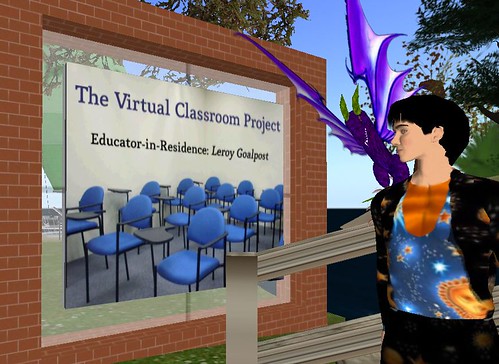
Virtual Classroom Challenge

Today I joined the April Festival on Jokaydia to listen to Leigh Blackall describe his Virtual Classroom Project. He was challenged by Konrad Glogowski and Jokaydia owner Jo Kay to build an "ideal learning environment" in just one month in Second Life.


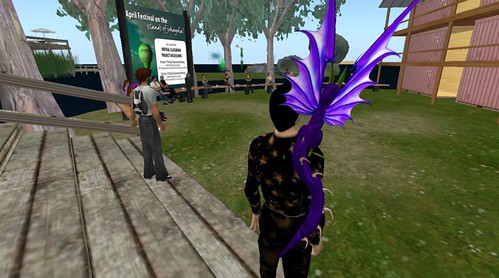
That's me above - with Puff my purple dragon on my shoulder.

Leigh described how he used permaculture principles to create a more "holistic" learning environment with "efficient use of space and resources; space design that is conducive to inquiry learning and skills training; and with every single aspect serving some form of opportunity for learning." (Leigh's Blog)

Leigh used (virtual copies) of recycled shipping containers to create a fascinating design that did indeed provide a wide range of learning opportunities. See his second post and project wiki for many more details.

Leigh's presentation really made me think about what we might build on the parcel of land Hobart College has rented in Jokaydia. Access problems to Second Life from within the college IT network have delayed our building over the last few weeks but perhaps that is not all bad... time for a rethink...

Saturday, 23 February 2008

Doing IT Differently - IT begins...

We are one week into the academic year now and much has happened... This PowerPoint explains the purpose and thinking behind the Student-Directed Inquiry course - the new TQA syllabus designed to stimulate learning skills and ways of thinking for work, study and life in the 21st century. (PowerPoint with notes - click/hover top left corner icon on each page - for those with access to our Moodle.)

Students have signed up for some of the online services that we will use to help us keep the learning personalised and flexible... Twitter, Google Reader and 43Things.

For those who would like to read a blow-by-blow description I've started a new journal HC Interactive Media.

While I've used these tools and processes with classes in the past this is the first time that it's all been coherently integrated... It's early days yet but things are looking very promising.

Exciting stuff!

Wednesday, 9 January 2008

Doing IT Differently - H: What's Missing?

What will be different at HC in 2008?

H: What's Missing?

In this series I've focused on changes in the Computing learning area. Of course there are also new initiatives in other learning areas and I hope to write about some of those over the next few weeks.

In the last post of this series I'd like to touch on a couple of things I think are still missing if we are to engage all learners in education that leads to purposeful futures.


The first is Social Foresight or Futures Studies. We need to empower students with the knowledge and tools to be able to predict likely futures and create preferred futures - both personal and societal. However we have done little in this area and it has not been a priority in current course development work. This must change.

In the Computing area there are several avenues for exploring possible and preferred futures:

  • Robotics
  • Artificial Intelligence
  • Technological solutions for current local and global challenges
The emerging field of Integral Futures might provide a way for students to use 4 Quadrant Integral Theory as a framework (see F: Conceptual Frameworks) to map possibilities.

The second is Spirituality. Spirituality is recognised in state and national educational policy but progress in this area has been slow until recently. We need to look for opportunities to address:

  • students' sense of deeper meaning, connectedness, purpose and place
  • spiritual literacy and spiritual expression
  • inspiration and wisdom
  • mindfulness and stillness

Above Maslow's need for self-actualization is the need for self-transcendence - a need to be of service to humanity and the planet. Today's global challenges provide many opportunities for expression at this level.

Previous: G: Blended Learning

Tuesday, 8 January 2008

Doing IT Differently - G: Blended Learning

What will be different at HC in 2008?

G: Blended Learning

Blended Learning involves the use of multiple learning environments - usually some combination of physical/face-to-face and online/virtual approaches.

Over the last few years we have gradually expanded our use of online/virtual technologies for learning, teaching and assessment - both in the range of technologies and the number of students involved (see below).

Our range of physical/face-to-face approaches has also expanded over the same period to include team teaching, coaching/mentoring, workplaces, simulated work environments, open/flexible learning, regional annexes and others.

HC students and teachers in the virtual world Skoolaborate - 2007


In 2008 we will attempt to provide more seamless physical/online blended learning environments for all computing students (and several other courses) 24/7 whether they are on campus, at home or even in some workplaces. These environments will involve the following:

  • A formal online environment where the class can store and share documents, discuss topics, pose questions and collaborate. We will use Moodle and ELGG services hosted off-campus and MS SharePoint Portal hosted on-campus.
  • Presence and communication where students and teachers can be seen to be online and exchange information and files 24/7 as required. MS Office Communicator will be mandatory for all computing students. Other systems commonly used by students are Live Messenger, Google Talk, Facebook/Myspace, SMS... (Email is infrequently used for communication by the majority of students.)
  • Virtual worlds where students and teachers can meet, complete tasks and create through personalised avatars in persistent online environments. We will expand our use of Skoolaborate and we also want to rent some education space for teachers to meet interested parents.
  • Game worlds where students can roleplay, complete tasks and create new environments. We will expand our use of Neverwinter Nights begun in 2007 - and also our use of serious games such as PeaceMaker also trialled in 2007..
  • Mobile Learning where students use mobile phones, game consoles, MP3 players and laptops to engage with course materials on and off campus.
  • Mobile Desktop and RSS where students can integrate their online identities and interactions - educational and social - in a one-stop-shop. We will promote Google Desktop and Facebook although students may choose another service.
  • Networked Learning where students connect - and hopefully engage - with professional communities of practise in their learning area. We will promote the Bloglines and Google Reader aggregation services although students can also bring RSS feeds back to Moodle, ELGG or even Facebook.

Previous - F: Conceptual Frameworks Next - G: What's Missing?

Monday, 7 January 2008

Doing IT Differently - F: Conceptual Frameworks

What will be different at HC in 2008?

F: Conceptual Frameworks

The shift in focus from information to knowledge and understanding - and even wisdom - has emphasised the need to highlight concepts, conceptual lenses and conceptual frameworks in curriculum design - as well as learning and teaching. (eg see Concept-Based Curriculum and Instruction by Erickson)

However, although conceptual frameworks are used by educators in research and curriculum design they are not as often given to students to help them make their own connections.

Over the last few years a number of colleagues have supplemented their teaching of the usual topic or subject based concepts (eg 'values', 'texture', 'evolution' or 'sustainability') with more integrative frameworks such as Senge's 'systems framework', Gardner's 'multiple intelligences framework' and Wilber's 'four-quadrant framework'. The response from students has been very positive.


In 2008 we plan to introduce integrative frameworks to computing students - particularly those doing interactive media involving Student Directed Inquiry (see previous post). We will continue to use integrative conceptual frameworks with students in English, Media and our academic achievement program.

Integrative conceptual frameworks help students to:
  • move their thinking to the metacognitive level - thinking about thinking

  • make sense of transdisciplinary inquiry - required in the Student Directed Inquiry course

  • make connections to their existing knowledge and understanding

  • know what they don't know - and know where to find out

  • transfer learning to new situations - and cope with rapid change

  • understand the importance of worldviews - and the need for collaborative inquiry
Exactly how we will use integrative conceptual concepts with computing students still needs to be worked out...

Previous - E: Assessment of, for and as Learning Next - F: Blended Learning

Saturday, 5 January 2008

Doing IT DIfferently - E: Assessment of, for and as Learning

What will be different at HC in 2008?

E: Assessment of, for and as Learning

Over the last three years we have had a close look at our assessment practices clarifying the pros and cons of formative and summative assessment - assessment OF learning, assessment FOR learning and assessment AS learning. (See also Assessment is for Learning - Scotland)

Key Assessment Principles have now been integrated into the K-10 Tasmanian Curriculum and the Post Year 10 Curriculum Framework - as well as into the learning, teaching and assessment practices of many teachers. Note that Tasmania uses criterion-based assessment with competency-based assessment for vocational courses.

In 2008 we will more formally implement, for a larger number of students, a range of assessment practices that we have successfully trialled over the last few years


  • self and peer assessment - students will be supported to use a number of self assessment tools designed to facilitate assessment AS learning. A key part of this process will be reflective online journals (blogs and microblogs) - reading, writing and commenting.

  • formal assessment - existing courses have been redeveloped and new courses written to incorporate a broader range of formal assessment processes: folios, logs, presentations... while the traditional end-of-course written exams have been shortened or even eliminated in some cases.

  • course assessment options - with a focus on personalised student learning comes the need for greater flexibility in assessment options. Computing students will be able to negotiate to be assessed against the most appropriate course well into the teaching year. For some this might mean assessment in national vocational modules as well as a TCE course for the same class.

Previous - D: New Curriculum Next - F: Conceptual Frameworks

Wednesday, 2 January 2008

Doing IT Differently - D: New Curriculum

What will be different at HC in 2008?

D: New Curriculum

During 2004/5 a new Curriculum Framework was developed for years 11/12 and in 2006/7 courses were written and new initiatives were trialled based on this Framework. Parallel with this process Post Year 10 education is being restructured with an integration of Senior Secondary Colleges and TAFE to give a multi-campus Polytechnic, a multi-campus Academy and a Training Enterprise as part of the Tasmania Tomorrow strategy by 2009.

In 2008 we will implement Computing courses re-developed based on the new Framework as well as the new course Student Directed Inquiry. In our case Student Directed Inquiry (SDI) will be offered in the broad area of Interactive Media and will allow students to conduct transdisciplinary inquiry in areas of personal interest. The aim of the SDI course is to "promote learning skills and ways of thinking essential for the development of self-directed, self-managing, lifelong learners in the 21st century."

Teachers and students will work closely with a programmer with extensive experience in the games industry who visited the college during 2007. Although this course does not begin until February 2008 six students have already formed a production team and have had long planning meetings!

A key feature of our curriculum implementation in 2008 will be that learning will be personalised and will not be rigidly bound by syllabuses, timetables, assessment or classrooms. These structures will be interpreted as frameworks only - students and teachers will be able to determine the exact nature of their own learning, teaching and assessment.

The focus will be on student learning that creates:
  • Insightful learners who can access, apply, transfer and create knowledge;
  • Individuals who are self-directed and ethical;
  • Citizens who are engaged, active and responsible in their community; and
  • Forward thinkers who can apply their skills and understanding to successfully participate in work, society and future learning.
Previous - C: Social Learning Next - E: Assessment of, for and as Learning

Tuesday, 1 January 2008

Doing IT Differently - C: Social Learning

What will be different at HC in 2008?

C: Social Learning

A number of colleagues have already started using Web 2.0 tools with their students or other educators. A couple of classes were even assessed on their social bookmarking and MySpace pages. A few English students created MySpace pages for fictional characters they were studying and MySpace layout and content was assessed in some Media subjects. The majority of students on campus had MySpace pages.


In 2008 selected social learning (web 2.0) tools will be integrated into learning, teaching and assessment for a large group of students.


  • Social Bookmarking - students will be encouraged to keep and share bookmarks online using del.icio.us. The college has already established a number of accounts for some learning areas eg journalism, game design, learning2learn, multimedia
  • Research - Google Notebook will be used for making, collating and sharing notes while researching online.
  • Journals (Blogs) - students will post to online journals - tagged according to topic and/or assessment criteria - and students will read and comment on other student journals or international blogs. A number of customised services will be provided including Moodle and ELGG - or students can use another service and provide an RSS feed for class aggregation.
  • Microblogging - particularly recommended for students engaged in student directed inquiry projects - using Twitter or Jaiku.
  • Social Networking - students will be encouraged to establish a digital identity and presence that will get them "hired not fired". Facebook will be the preferred site for linking students on campus and for specialist groups established for some classes. 43 Things may be used by some students to set learning and life goals.

A number of services will be used to aggregate various feeds for students and teachers including Google Reader, Bloglines and ELGG. At this stage there is no extensive use planned for wikis in 2008.

Previous - B: Personalised Learning Next - D: New Curriculum