(This work is licensed under a Creative Commons License.)
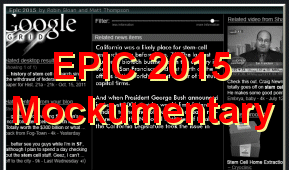
This great Flash mockumentary by journalists Sloan and Thompson (thanks for the links Pete) explores the possible death of print media (NY Times) in a media 'history' from the birth of the WWW in 1989, through the births of Amazon(94), Google(98) and Blogger(99), the pivotal 'Web2.0' [my term] year of 2004 and into 2015 when the NY Times is "just a newsletter for oldies"...
According to columnist John Leo:
"Rupert Murdoch, speaking at the recent convention of the American Society of Newspaper Editors, advised the group to encourage their readers to use the Internet more as a supplement to print coverage He warned that newspapers risked being "relegated to the status of also-rans" if they don't make use of the Internet. Columnist Rick Brookhiser had a blunt comment in the New York Observer: Murdoch was just being polite--what he meant is that newspapers are dead."
I recently discovered from Tim Lauer's blog that the NY Times is now podcasting. :-)
(There is an earlier version called EPIC 2014 which has some interesting differences...)
I wonder what an 'history' of education from 1989 to 2015 would look like? Educational possibilities for around 2015 is something a number of edu-blogs have been exploring over the last couple of months... eg 2Cents Worth
How much leadership and wisdom will educators (and students) inject into the educational version of 'EPIC'? (Will there even be an distinct education version?) Will it all 'just happen' without direction from educators? Will it be superficial or deep?
The time to co-create preferred educational futures is certainly NOW if we want to move into the best of educational times... Fortunately we are onto it :-)

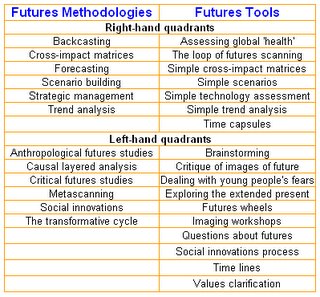 Slaughter maps pop futurism, problem-oriented futures work, critical futures studies, epistemological futures, and environmental scanning across Wilber's quadrants showing the strengths and gaps in each approach over the last century.