Saturday, 30 December 2006

Engaged Learners

Many new curriculum talk about "engaging learners". For example, our new state curriculum framework for years 11/12 is about "enaging with all students in the learning that will empower them to create and realise purposeful futures."

I've been reading some blog posts questioning what it means to be an 'engaged learner', what's new about 'engaging learners' and how you might assess 'engagement'. Some good provocative questions - and they got me thinking...

While I can point out engaged learners in most classes at my school it is clear that not every student is engaged - some are disenaged and some (many?) are passive learners. But before jumping too quickly into how I 'know' this I thought I should start to map what makes an engaged learner. Then perhaps I can talk about whether it can be measured...

From my own experience and reading things like this and this I've mapped out the following (still needs work):

The blue boxes represent engaged learning processes while the green boxes show some common curriculum goals/intended outcomes. (If you use CMaps and want to edit it you can find it in Public spaces (2) --> Curriculum 2006 (userid:hent password:blog)


No wonder enagement is hard to pin down - let alone assess. On the other hand most teachers can tell when a student is really engaged in their learning... mostly through observation and conversation - you can often see it in their body language and hear it in their voice.

I think I'll let this sit a while before thinking about if and/or how one might measure the degree of enagement...

Thursday, 28 December 2006

Assessing in VET - Freedom, Structure and Personalisation

One of the classes I teach is a year 11/12 vocational education class in Information Technology - a combined Certificate 2/3 class. The course is actually a double class of 9hrs per week and is assessed against both the AQF VET Certificate competencies and the TQA Vocational Learning criteria. I recently gave a presentation showing how this course is structured and assessed.

The slides are linked below but they need some explanation... (names and faces have been blurred for privacy)


The course has been designed to meet a number of needs:
  • the wide diversity of student IT knowledge/skills/understanding
  • the lack of some specific IT knowledge/skills by the teacher(s)
  • the requirement for students to experience a real IT workplace
  • the efficient management of assessment as learning, for learning and of learning

The wide range of student expertise provides both challenges and opportunities. Each student needs a personalised learning program based on what they already know and what they need to know. Each student knows something the others do not and can therefore help to teach. The course is highly structured to provide individual student freedom across multiple learning opportunities/environments. (See slides above for more detail.)


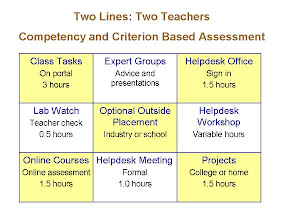
The course has nine learning environments.
From vet_assessment

Students progress at their own pace through a list of class tasks; they form expert groups to research and present information; they work in a Helpdesk Office servicing 1100 students and staff; they maintain one of the ten campus computer labs (lab watch); they may opt to work in an outside business/industry; they maintain hardware in the Helpdesk Workshop; they complete online courses; they attend and run formal Helpdesk meetings; they work on projects on site, in the workplace or at home.

Some online courses are mandated and others are chosen by students. We use online courses provided by SkillSoft (purchased), Microsoft Training (free) and other internet sites.

This year I was involved in team-teaching the course with Jon - in previous years I have taught the double-class myself. How do I manage and assess all of this? Over the last few years I have evolved the following management and assessment strategies.

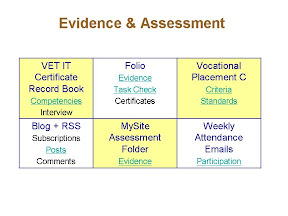
Evidence of student competency is collected by the students and collated using a number of ICT tools.

From vet_assessment

Each student collects evidence of their learning in a digital (MySite) or paper-based folio (most did both). This includes certificates from online courses, photo's from the workplace, project report forms, client evaluation sheets, class tasks... Students either write a blog or write in their paper-based folio (most chose a blog) about new technology (they subscribe to RSS feeds) and reflection on their learning. Each week every student replies to an email detailing participation across the nine learning environments.

I sit down with each student as and when required and sign off specific VET IT competencies in their formal Record Book and validate their self assessment against the Vocational Learning criteria. It all works quite well :-)


PS I'm playing with google - personalisation, widgets, picasa... and upgrading my blog - that's why you may have got the whole blog as a 'new post' in your RSS feed...

Saturday, 21 October 2006

Knowledge and Slowness in Learning

Knowledge workers need to know how to use tools and frameworks to do their jobs according to Charles Jennings, Global Head of Learning at Reuters UK. Jennings painted a clear picture of the way workplaces have changed over the last 20 years on day 2 of the Global Summit 2006 in Sydney:

  • 70% of jobs created in the USA since 1998 have been for "knowledge workers"
  • "knowledge worker"jobs now make up 41% of all jobs in the USA (2005)
  • only 20-30% of workplace performance is knowledge/skills related (2005)
  • people learn 80% of what they need to know informally on-the-job

He cited Kelley's longitudinal study showing how the amount of knowledge that we need to know in our own minds to do our jobs has changed: 1986 - 75% ... 1997 - 15-20% ... 2006 - 8-10%

Jennings spoke of the need to shift from training to learning; of the need to know less and learn more; of the need for workers to have tools and frameworks to locate and process what they need to know when they need to know it.

And now for something completely different...

Geetha Narayanan from the School of Art Design and Technology, India presented two concepts. The first was the importance of digital story telling - showing how young disadvantaged people can be empowered to use cameras and recorders to tell their own powerful stories. And to tell them so well that they win international competitions.

The second was the notion of "slow schools". Narayanan spoke of the importance of health and well-being among today's technology rich, fast-paced and consumer oriented middle-class learners. The slow school idea was spawned by the slow food campaign which began as a protest against fast-food outlets but is rapidly becoming a global movement and has recently been popularised by TV chef Jamie Oliver as slow food moves into schools and begins to transform education...

Slow schools look for opportunities to slow the pace of thinking and move to being in the moment. Narayanan gave examples of moving students from thinking about the sun to embodying and being the sun as they sit in circles with feet touching, or slowly draw 10 suns rather than one, or as they dance watching sunrise...

Slow schools allow time for discussion and reflection - and focus on how students form concepts and make meaning.

Co-incidentally my blog reading recently introduced me to "slow design" and "slow cities" - the latter is already a network of 100 towns in 10 countries embodying the 'slow' metaphor.

Perhaps this brings new meaning to the concept of the slow learner :-)

Wednesday, 18 October 2006

Can Schools Save the Planet?

If politicians are talking about global warming it must be VERY serious according to Robert Cailliau, a co-inventor of the world-wide-web, who spoke at the Global Summit 2006 yesterday.
Cailliau suggests that educators need to consider the role of education in addressing some of the most challenging issues that face the planet today. But how? What knowledge, skills, understanding, apptitudes... will help learners to help the planet?

Einstein reminded us that you can't solve problems with the same kind of thinking that created them. What kind of thinking do we need in educational institutions and how will it be different?

We can talk about engaging and empowering students to be active learners and global citizens in a technology connected world but what about different ways of thinking?

Is it about looking at principles of sustainability and social justice such as those expressed in The Earth Charter ?

Is it about the knowledge and skills and understanding of futures thinking and social foresight?

Is it about challenging our assumptions and worldviews and using more holistic or integral ways knowing and being?

If we don't "think differently" how as James Boscoe asked delegated do we know we won't be sitting at conferences in 20 years time asking ourselves the same questions? Or perhaps we won't have the luxury of being able to sit in conference buildings... at least where they are built now anyway...

Saturday, 14 October 2006

Designing Courses: Learning Areas and Capabilities

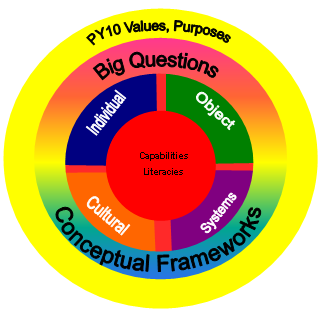
I've been playing with models that might clarify the process of designing courses in order to provide for all students under the new Post Year 10 Curriculum Framework for Tasmania. I've also been reading about the current call for a "back to basics" national curriculum and in particular thinking about Alan Reid's proposal's in Rethinking National Curriculum Collaboration - but within a State rather than national context. (School education is the constitutional responsibility of the States in Australia.)

Before the current PY10 Curriculum Framework was developed the structure of the curriculum was hard to conceptualise. In the late 80s and early 90s traditional subjects were loosely grouped into 'learning areas'; new programs to support literacy, numeracy and ICT literacy were developed; new courses emerged and some stayed; student support, health and well-being and career/pathway options evolved; key competencies/capabilities were identified...

However much of this sat outside traditional subjects/leaning areas - conceptually and often in implementation as well - or sometimes uneasily within syllabuses and timetables as attempts were made to "embed them".

Syllabus development most often occurred within subject/learning areas and tended to reinforce existing knowledge structures, ways of learning, teaching and assessment. New courses often failed to gain a foothold if they did not fall neatly into traditional ways of organising knowledge.

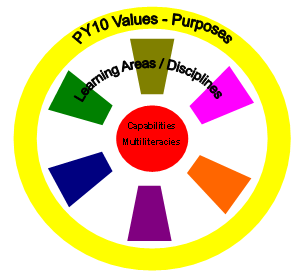
The new PY10 Curriculum Framework is based on agreed values and purposes arrived at during a long period of co-construction. We are currently looking at the structures and processes that might inform the provision of courses within the Framework. What range of courses will be available to choose from?

While we now have a State Curriculum Framework individual year 11/12 schools will be responsible for implementation to meet student needs in local contexts. Which courses will schools choose to offer their students? And how will individual classroom teachers interpret these courses?

(NB In this graphic the number of learning areas is arbitrary.)

A key question at the moment is what sits between the values and purposes and the capabilities/literacies? What are the contexts for learning? Can we move away from learning areas? Should we move away from learning areas? Following Reid's suggestion (in the above paper) can we develop courses where students learn for the capabilities through the learning areas - leaving the details of what learning to schools, teachers and students?

Or will existing ways organising knowledge/skills and their associated communities of practice work against providing opportunities to develop all the capabilities required for the 21st century? Will anything really change if traditional learning areas still dominate structures and processes for course/syllabus development.


And where do transdisciplinary approaches fit? How do we move beyond disciplines to engage in the kind of rigorous thinking that is needed to meet today's societal and planetary challenges? Can we construct valued learning experiences/courses that exist in the space between the disciplines and their well developed resources/support structures/dialogues?

Perhaps we need to use other lenses/conceptual frameworks to help us create courses/learning experiences that help students to make meaningful connections beyond subject borders and to "know what they don’t know". Can we generate meaningful content/contexts by asking the big questions? Is an 'integral' lens useful as a conceptual framework?

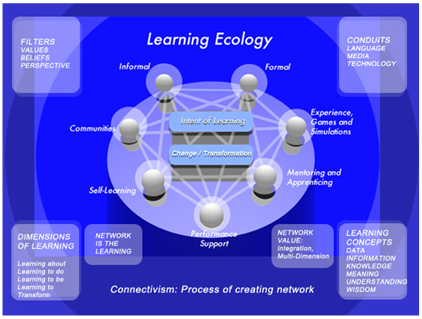
Perhaps course developers and classroom teachers (hopefully the same people) need to draw on a course development toolbox containing a variety of conceptual lenses... A learning ecology/connectivism framework such as the following by George Siemens that looks at "know where" as well as "know-how" and "know-what" might be one tool.

And how can we establish course developement models/principles that ensure the ongoing currency of courses in today's rapidly changing world?

Saturday, 23 September 2006

Not enough time for...


Not enough time for teaching... to cover the syllabus/curriculum...
Not enough time to pick up new skills... to try new things...
Not enough time to reach each student... to personalise learning...
Not enough time to have professional conversations... to co-construct...


How can we use time differently?

I've been thinking about how my own use of time has changed over the last few years - both in and out of class...

In class I now...
  • offer online learning and printed resources instead of writing notes on a board
  • use student self/peer assessment to complement my assessment
  • spend less time assessing and when I do it's usually sitting down in conversation with each student
  • spend more time listening to student presentations
  • spend more time online - viewing student work, commenting on blogs and in other student spaces, setting new tasks, researching links for just-in-time teaching...
  • expect students to ask more questions rather than just provide "answers" to my questions
  • spend more time showing a few students something and then asking them to show others
  • expect students to ask each other (or seek online help) before asking me
  • learn something new from students instead of always teaching/facilitating

Out of class I now...

  • dictate text rather than using a keyboard (and more recently produce podcasts, screencasts, videocasts rather than written documents for class or other teachers)
  • use electronic calendars with meeting functionality
  • use IM instead of email to make casual contact with students and colleagues
  • walk into other classes and chat with teachers/students
  • do much less preparation for class and much less assessment

At home I now...

  • read work emails in morning before going to work - (take time off in lieu when appropriate)
  • read blogs instead of morning newspaper - (a much more uplifting experience)
  • participate in online events - conferences, seminars, courses, meetings, blogging - (take time off in lieu when appropriate)
  • work from home with high speed internet access to school resources - (take time off in lieu when appropriate)
So the way I use time has changed... even more than I'd realised...

Was it easy to change? No! There was a transition period where I was trying to do what I had always done while trying new things - spending too many hours at work and home - not healthy :-)

But I soon discovered that students
  • do just as well if I don't assess everything
  • learn just as much if I don't write everything on the board
  • take more responsibility for their own learning if I don't always provide the "answer"
  • learn just as much from each other as me
  • can still cover the course if they take time to research and present to the class themselves
Plus I have found that I can do some work tasks much more efficiently from home.

Many of my colleagues however still spend a great deal of their time preparing and assessing work while trying to read emails and adapt to new curriculum. For many Wednesday feels like Friday. It's not sustainable.

For these teachers self/peer assessment is not believed to be realistic. Taking time to do anything other than "cover the curriculum" is believed to be time-wasting. Learning new skills in IT is seen to be impossible given the lack of time...


Graphic from MS Clipart: Non-commercial use

Friday, 22 September 2006

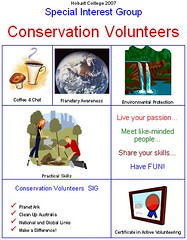
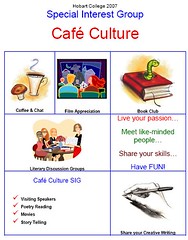
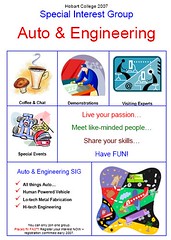
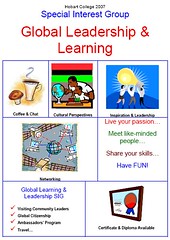
Special Interest Groups

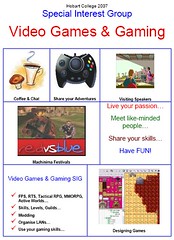
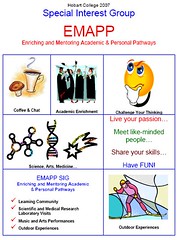
Next year we are planning to offer students the option of joining Special Interest Groups (SIGs) that are tied to our normal mentor/counselling groups.

In the past all students were timetabled to attend a mentor/counselling group for 30 mins once a week with a teacher. This year one of these groups was set up around a student area of interest so that rather than students having a common teacher or subject they have a common interest. It has worked very well with much better attendance and enthusiastic participation.

Several groups of teachers have now decided to offer a range of such Special Interest Groups for 2007. The idea is that two or more teachers will combine their mentor/counselling groups to form a larger group that is facilitiated by a team of teachers. Students are curently nominating a SIG on their 2007 enrolment forms.

Student interest has been very high. The details have yet to be worked out but in essence the groups will have one timetabled meeting each week with other activities organised by teachers, students or memebers of the wider community.

gamingemapp

conservationcafe

autoglobal

outdoorStudents will be offered coffee and raison toast (a big hit with this year's group) and special events in and out of school.

We still have many details to work out but the notion of a group of heterogeneous students meeting and chatting about an area they are passionate about has a lot of appeal...

Today I read about the Virtual Learning Commons at the University of Manitoba via George Sieman's blog. This is a great idea and I'm wondering if we can extend the special interest concept to self-organising student groups as well - even if they are just virtual.

Should we get our students to use 43 Things and add a tag for our school so that students can find each other or should we (could we) do something like the U of M?

Sunday, 17 September 2006

Transformational Leadership Frameworks

Five Conceptual Frameworks for transformational leadership focussing on "generating the breakthrough insights needed to generate new commitments, behaviour, and results for individuals, institutions and societies."

I've just read Monica Sharma's article in the latest issue (No.12) of shift from IONS. She describes an integrated "transformative leadership" methodology she helped develop for the United Nations Development Program in 2001. Her Transformative Leadership Development Program (2005) has now reached 4.5 million people across 40 countries with a particular focus on creating leadership capacity to help countries respond to HIV/AIDS.

According to a report on the UNDP European website the Five Conceptual Frameworks provide easily transferrable tools for transformation that have been effective at all levels of society and across diverse cultures.

What would happen if we used these tools for educational change? And also for empowering students as we promote global citizenship?

Sharma's five frameworks for transformative leadership (Annexes 3) are:

  1. Leadership Competencies and Distinctions
  2. Emotional Intelligence Framework - based on the work of Daniel Goleman
  3. Four-Quadrant Framework - based on the work of Ken Wilber
  4. Levels of Organisational Development - based on the work of Rensis Likert
  5. Dynamic Strategic Planning Processes - based on appreciative inquiry

These frameworks are used within a systems thinking approach based on the work of Peter Senge.

According to Sharma the frameworks provide conceptual maps that "suggest ways of perceiving, understanding, and interpreting the world that may be different from our usual conditioning."

She says the Transformative Leadership Development Program (TLDP)

"emphasizes that the level of learning necessary to develop transformational leaders goes beyond sharing theories, learning new techniques, or gathering information. It is a process that actually works at a level deep enough to discover and shift who people are being, not what they know; it is for individuals who are ready and willing to be learners and to engage in a process of profound personal growth."

Sounds like something we need in our education systems... :-)

I like the way the TLDP not only uses coherent conceptual frameworks as a kind of holistic lens that highlights multiple aspects of an issue, but also the way several frameworks are integrated to provide a multidimensional picture of a system... hopefully giving a better chance for sustainable systemic change.

Which frameworks/tools would best facilitate educational transformation? Would the same set also be appropriate for students involved in leadership?

Perhaps Gardner's Multiple Intelligences Framework could be added to Goleman's Emotional Intelligence Framework? Perhaps Grave's Spiral Dynamics could be added to Likert's framework? Perhaps Senge's U-Process could be added to the strategic planning processes?

There is certainly no shortage of tools! Do we know how to use them? Can we afford not to use them?

Sources:

Sharma, M (2006) Conscious Leadership at the Crossroads of Change in shift (No.12): IONS

UNDP Report Annexes 3 - Accessed from UNDP European website on 17th Sept. 2006

Monday, 31 July 2006

Learning from Gaming

As educators we would like to try to engage teenagers in learning. Video game developers have to engage teenagers in learning - or they are out of work! I've just read James Gee's Why Video Games are Good for Your Soul and have much to reflect on...

Gee believes that good video games give people control, agency and meaning while promoting deep learning that closely aligns with the learning that has often been identified as necessary for the 21st century - creative problem solving, metacognition, systems thinking, transformative learning...

Gee believes that video game developers do this by:
  • giving people well designed visual and embodied experiences
  • helping people to use these experiences to think imaginatively about future actions
  • letting people safely experience the consequences of their actions
He believes that game developers use the latest research from neuroscience and are guided by many "learning principles" such as:
  • learning is experiential
  • learning should encourage risk taking
  • learning is an extended engagement of self
  • learning can be customised to suit learning styles
  • problem solving leads to generalisations that assist in solving more complex problems
  • learning is "just in time" or "on demand"
  • learning is interactive
  • there are many ways to solve a problem
  • there are intrinsic rewards keyed to the learner's level of expertise
Gee points out that in spite of their success at engaging learners few video game publishers associate their products with 'learning' - too much negative baggage associated with that word :-)

I am not a video game player... the last games I played were mostly in the late 80s... minesweeper was about as far as I got... but I now think that there might be much to gain by looking at the ways in which good video games engage teenagers - partly because most of our teenagers are so-called "digital-natives" - and partly because I know that the majority of our students play video games - particularly males - and to very high levels.

How is it that strategy games like Rise of Nations can build player skills and knowledge to the point where they are thinking and operating across space and time in many complex relationships to create a well integrated and sustainable civilization - all for FUN?

As Gee says: "This is heady stuff indeed. This type of thinking is the very hallmark and foundation of the deepest and most complicated thinking in the sciences. Biologists, physicists, and social scientists must think in these sorts of ways in order to study the complex systems they are engaged with."

In the book Gee outlines the many ways in which different kinds of video games engage both individual and multiple players in virtual worlds from first-person to god-like perspectives... each type of game involving different player-game dynamics, skills, knowledge and development.

Another aspect that interests me at the moment is the way in which video games encourage players to move up levels gaining expertise and experience... Can we learn something here about good assessment practice?

Tuesday, 20 June 2006

The Lives We Lead...


I had a great chat with Australian educator Jo Kay earlier today on the deck of one of her properties in Second Life. Jo is doing much to help network Australian educators interested in the application of Web 2.0 technologies to learning and teaching - she is about to launch activities through the Austlalian EdNA group eCommunicate 2.0

We touched on many topics of mutual interest in 'First Life'.... accessing Second Life behind ever present firewalls.... giving students control over their own learning resources and products.... use of portal technologies.... the pros and cons of hosting spaces for students in-house....

There is something very engaging about chatting with someone - even via text - when you can see them moving - albeit an avatar. This medium has enormous potential and I'm keen to get some colleagues involved...

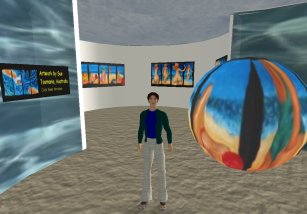
I've spent the last week learning to build on a piece of land I've bought in SL. It's on an island in a region called Eldora - above the snowline. It cost me L$2,250 and I'm building a gallery to show off some of my wife's art work... I even managed to get a ball rotating :-)

To learn to build I had to do a course - which was a fascinating experience in itself.... The course in building using 'primitives' was laid out on several floors of a building called Ivory Tower Library. Each floor had several 'stations' set out with sample models, instructions and a place to try it out for yourself... You can do the course in any order, take as long as you like, repeat steps as often as you like... and chat to others doing the course with you...

Lots of foundational mathematics and physics is involved in all of this - something many students might be interested in learning in this way... It's amazing what you can make with some basic shapes and a little maths and physics :-)

Jo has linked me in with an educational community on Second Life so I'm looking forward to some interesting conversations and experiences...

Monday, 12 June 2006

Curriculum as Connectivism

I've been reading with interest George Siemen's blog and wiki on 'connectivism' talking about learning as network creation and how we might provide 'learning ecologies' to meet the needs of students. I'm finding these concepts very useful as we look at planning the implementation of the new Curriculum Framework. But before I launch into that I've been trying to place connectivism as a curriculum metaphor within an Integral AQAL Framework... particularly after reading his last post revisiting a discussion on subjectivity and objectivity.

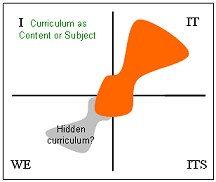
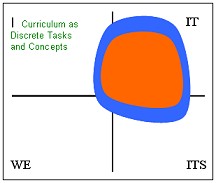
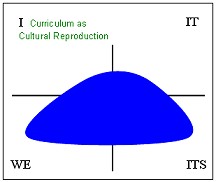
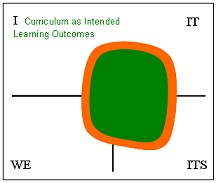
I've looked at this before with some simplistic (perhaps too simplistic) mappings of other curriculum metaphors onto Ken Wilber's subjective/objective/individual/collective quadrants (270Kb). The different colours refer to waves from Spiral Dynamics... Blue as rule-self, orange as achiever-self, green as sensitive-self, yellow as integral-self... but I'm mostly interested in which quadrants these metaphors map into... at least in the way they have usually been implemented.
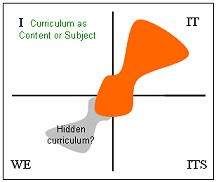
Curriculum as Content or Subjects: This metaphor portrays a traditional image of curriculum that stretches back to Pythagoras and Plato. This curriculum is one which receives contents from traditional academic disciplines and transmits them to the learner.
Intent: Curriculum development centres largely on subjects, contents, timetables and booklists. Needs may be defined in terms of preparation for university, commerce or general study.
Criticism: Does not account for cognitive development, creative expression, and personal growth. Nor for planned and un-planned activities that are a major part of students’ experiences at school.
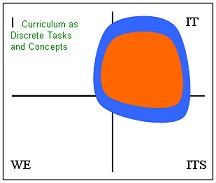
Curriculum as Discrete Tasks and Concepts: The curriculum is seen as a set of tasks to be mastered and is derived from training programs in business, industry and the military.
Intent: ‘Apprenticeship’ with an adult to gain certain knowledge and skills.
Criticism: Does not prepare the learner for a changing world. Suited to technical training rather than conceptual understanding.
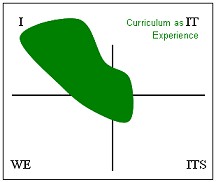

Curriculum as Experience: This image of curriculum, following John Dewey, emphasizes experience rather than sets of activities. Learners select a learning experience according to its significance in their life.
Intent: With this notion of curriculum, the learners have a key role in curriculum process. Experiences are created as learners reflect on the learning process.
Criticism: Students’ involvement in planning and selecting the learning experiences is very idealistic - they may not be able to decide which is of significance and which is not. How do you implement this in a large school?
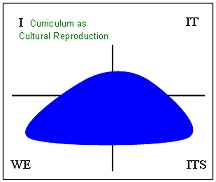
Curriculum as Cultural Reproduction: The curriculum metaphor is concerned with the notion of transmission of cultural knowledge and values from one generation to another.
Intent: To prepare the youth for the culture of a certain community, state and country.
Criticism: Helps maintain the status quo by transmitting middle class culture rather than that of the oppressed. Does not help develop critical thinking.
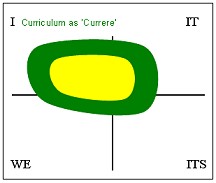

Curriculum as “Currere”: The curriculum is the interpretation of the learner’s lived experiences – the learner comes to understand their past, how it drives the present and how it directs the future of their personal and professional life. Individuals come to a greater understanding of themselves, others, and the world about them.
Intent: Freedom from unwarranted convention, ideology and labelling. To mutually fashion new directions for oneself, others and the world.
Criticism: Self-understanding is a parental responsibility. The search for self-knowledge requires professional therapists.
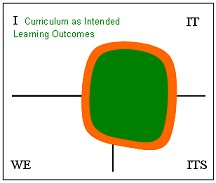
Curriculum as Intended Learning Outcomes: This image sees the curriculum as a process of goal setting and drawing a pathways to those goals. The outcomes are expressed in general terms like “understanding the value of…”. Today most curriculum frameworks have incorporated this image.
Intent: The curriculum is explicit and defensible. Teachers and students can determine their learning activities according to their needs and locale.
Criticism: Draws attention away from unintended outcomes relating to school culture and the hidden curriculum.


So... how does one map curriculum as connectivism? At the moment my reading places it mainly in the ITS quadrant - grounded in an objective systemic worldview but taking into account issues of social constructivism (WE quadrant) with a span across blue/orange/green and possibly into yellow memes. A much broader span than the other metaphors...
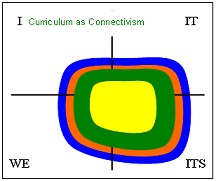
Curriculum as Connectivism: This curriculum metaphor is related to networks and network topology. It takes a systems view of learners and sees learning as network creation.
Intent: To provide a ‘learning ecology’ that the student connects with as and when appropriate.
Criticism: Favours self-directed learners.

This is potentially a richer way of seeing curriculum provision and I'm now interested to see how this metaphor might inform our discussion of how students choose their learning, what structures we might put in place to provide learning ecologies and how we can support students to make the necessary connections... more on this later.

Our leadership team have already found Sieman's Learning in Context powerpoint very useful (see also this pdf paper) and I'm hoping to see him in Sydney later this year...

The above curriculum metaphors (apart from the last one) are sourced from: Schubert, W. H. (1986). Curriculum: Perspective, Paradigm, and Possibility. New York: Macmillan Publishing Company.

Saturday, 10 June 2006

Holistic and Transformational Learning

The new Tasmanian Post Year 10 Curriculum Framework has just been released on CD. According to the overview document the Framework
"reflects an ‘holistic’ view of learners and learning with the experience of learning needing to extend beyond the informational to the transformational."
Our school curriculum team is now 6 months into planning for implementation. I thought I'd see if some of the current projects do indeed reflect an 'holistic' view and extend to the 'transformational'.

Project 1: New ICT Tools

This project is introducing a number of social software and presentation tools to students and teachers including blogs, podcasting, personal learning environments and digital story telling.

Do these tools enable holistic approaches to learners and learning? I think they could do... at least in the sense of students being able to express themselves through different media and teachers being able to have a fuller more inclusive view of the whole student. Jack Miller defines holistic curriculum in terms of inclusiveness, connection and balance. Social software certainly provides connections from local to global levels and I think it can also give a better balance between Miller's tensions of individual/group, content/process and assessment/learning.

Do these tools enable transformation? Some describe these tools as "disruptive technologies" - I prefer the term 'transformational technologies' but I strongly agree. I think these tools can transform the relationship between learner and teacher, can transform how students access and undertake their own learning, and can transform a student's understanding of their place in the world.

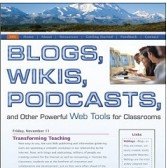
Is it working? Still too early to tell... about 15% of teachers are now using at least one tool in their classes and feedback has been very positive but we have a long way to go. 10 copies of Will Richardson's book (pictured) have been placed across the campus for teachers.

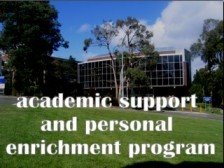
Project 2: Academic Achievement and Personal Enrichment

This project is providing support to a group of 60 students who are on traditional highly academic pathways. It aims to provide a learning space where students can learn together while at the same time challenging their assumptions and extending their involvement in 'non-academic' activities.

Holistic approach? Yes - this is an explicitly stated aim - to get these students to experience and express a more holistic sense of self including the physical, mental, social and spiritual.

Transformational? One part of the project that is well attended are sessions looking at enigma and anomalies (such as the evidence for advanced pre-historical civilizations) which attempts to question fundamental assumptions and worldviews based on transformative learning theory.

Is it working? Early feedback from students would indicate that it is achieving these intended outcomes. One student wrote
"The Tuesday afternoons sessions have helped me to learn a lot about myself and others. I love learning about how people think, interact and learn. Knowing these things has changed the way I perceive myself, my education and others. I always leave the sessions deep in thought with the inspiration for further investigation."

Project 3: Lo-Tech Metal Fabrication

This project is providing safe and easy access to metal work equipment for students across the college. The aim is to enable visual and performing arts students to integrate metal work into their projects without the need for training in welding and drilling.

Holistic approach? Not really... this is more about integrating skills from different subject areas.

Transformational? One aim is to encourage more females to consider metal work so in this sense there may be an element of transformation of the perception of metal as a male only domain.

Is it working? This project is still being set up with the equipment that has just been purchased.

Project 4: Human Powered Vehicle

This project aims to design, build and race a three wheeled human-powered vehicle. Students from Material, Design and Technology will work with students from Physical Education to measure the vehicles performance and race it in local and inter-state competitions.

Holistic approach? Yes in the sense that students will consider all aspects of this project and it will involve their physical, mental, emotional and social skills.

Transformational? This project aims to transform student attitudes to learning, empowerment and collaborative designing, making and appraising.

Is it working? Too early to tell - just in design stage...

Project 5: Integral Worldviews

This project introduces students to aspects of Integral Theory in an attempt to help them develop coherent conceptual frameworks that help them understand how values, assumptions and worldviews colour our perceptions.

Holistic Approach? Integral Theory by its very nature takes an holistic approach to human nature and knowledge.

Transformational? Students have reported that an integral approach does help them see things in new ways. Two students reported
"Openly challenged my way of thinking and what I personally believed in and accepted. Over-all very interesting and informative."
"Really insightful. Made me think life was more interesting… more to it."
Is it working? This project has been running for over a year and student feedback has been very positive.

Friday, 9 June 2006

Games and Gaming in Education


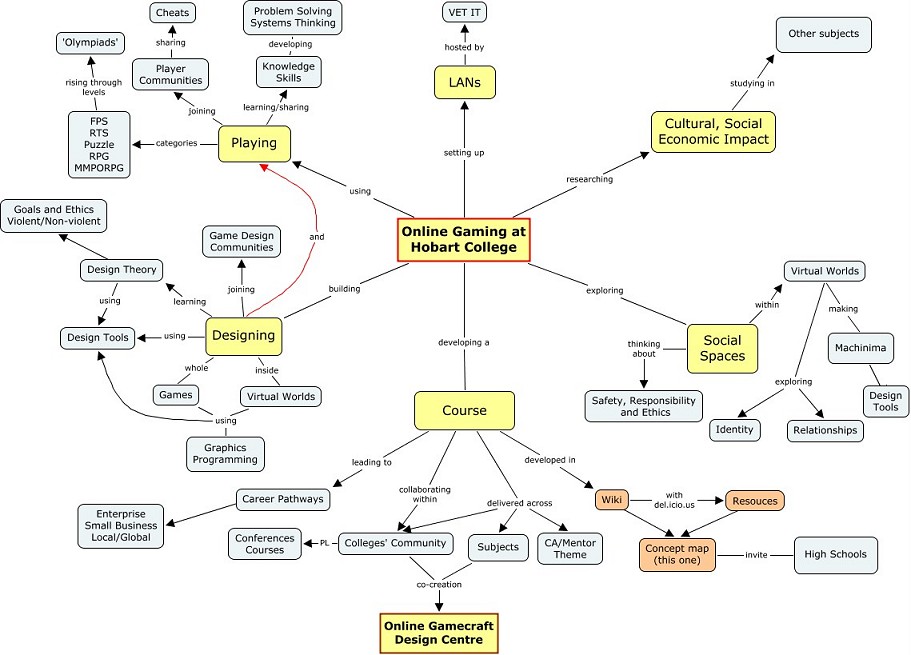
I've been having fun :-) A few teachers have been thinking about tapping into student interest in playing, socialising in, and designing online games. We have now committed to offering a game design course at Hobart College in 2007.

The reason I've been having fun is that I've put together my emerging understanding of concept mapping, blogs, wikis and a recently discovered audio blogging tool to see if we can collaboratively plan the new course with current and prospective students.

I've set up the above components on my college blog and await the start of next term with anticipation... students are on vacation at the moment... I'm quite excited to see if I can get some real participation... I'm also hoping to use IM to add another dimension to any collaboration between schools.

In the meantime I thought I'd blog about it here to reach existing expertise and wisdom... :-)

For background reading and ideas to extend this project beyond just designing games I've ordered Don't Bother Me Mom--I'm Learning! by Marc Prensky, Why Video Games are Good for Your Soul by James Paul Gee and 3D Game-Based Filmmaking: The Art of Machinima by Paul Marino. The latter was inspired by reading about machinima on Bud Hunt's Bud the Teacher blog.

Let the games begin...

Sunday, 21 May 2006

Stories Teachers Tell One Another

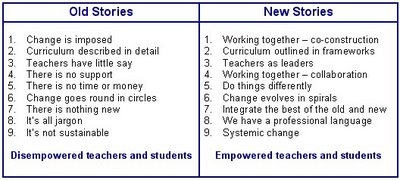
"There's nothing new" and "Stop using jargon" are two messages I get from some teachers. They are two of the many commonly used catch cries that make up the old story of educational change. These are the stories told by experienced teachers about the nature of educational change - or at least the kind of change that they have repeatedly experienced in their careers... and now the only kind of change that some of them can see...

Other teachers however are beginning to tell a new story. A story of "working together" and "doing things differently." While all teachers have been participating in the same educational change processes over the last two years the stories being told are not the same.


While the majority of teachers are beginning to use phrases from the new story I still hear some of the old story... It takes time to let go of the past... a process described in Senge's U-Process as 'letting go'.

One interesting aspect of this transformation from a past to a future view is that those teachers with the most clearly articulated stories of the process are those who have not let go of the past. They tell the old story with clarity and certainty while those learning the new story are exploratory and tentative. The result is that outside listeners can get the erroneous impression that the majority of teachers are disempowered and against change.

This then has a detrimental feedback effect on those who are starting to embrace the new story... causing them to second guess their emerging understanding and empowerment. That's one of the reasons I have found Senge's U-Process model so useful - it helps us understand the nature of the transformation process - and to see where we all are on the curve...

Of course out of this comes the opportunity to discuss, clarify and reafirm the new story. And hopefully the opportunity to move on with confidence into an emerging future.

Friday, 21 April 2006

The New Story

David Warlick has posted on the Types of New Stories we need to be telling as we implement 21st century curriculum. He has set up a wiki and invited educators to begin "hacking" some new stories.

I've already taken the liberty of hacking David's graphic to include 'shared vision' - a suggestion from a comment on his post - as well as changing 'reform stories' to 'curriculum stories' because I think we are involved in more than re-forming curriculum - there is a necessary degree of trans-formation going on as we move beyond traditional structures and processes. I've also tweeked some of the words to suit a local audience.

Perhaps a more extreme version of telling a new story is 'branding'. I've been trawling so-called "21 st century educational institutions" on the web to find some examples. I've mashed a few to get the following brands, slogans or banners:

  • Bringing knowledge to life
  • Learning for life
  • Community of inquiry
  • The world has changed. So have we.
  • School X: A learning community
  • School X: Wired for learning (perhaps that should be "Wireless for learning" :-)
  • School X: Your gateway to the world
  • School X: Where learning comes to life
  • School X: Building your confidence
  • Follow your interests… Discover your dreams…
  • Connecting learners with opportunities
  • Your learning – Our future
  • Got plans? We’ll show you how!
Any other ideas?

I also found a couple of interesting blogs on the subject - lots of $$$ and pitfalls here!
Marketing to College Students
Inside Higher Ed - Gaglines - with a link to a database with 150 taglines
Whisper

Tuesday, 18 April 2006

Literacy of Cooperation


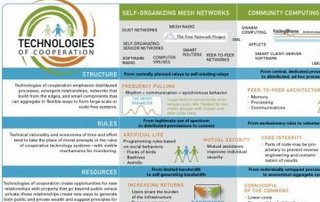
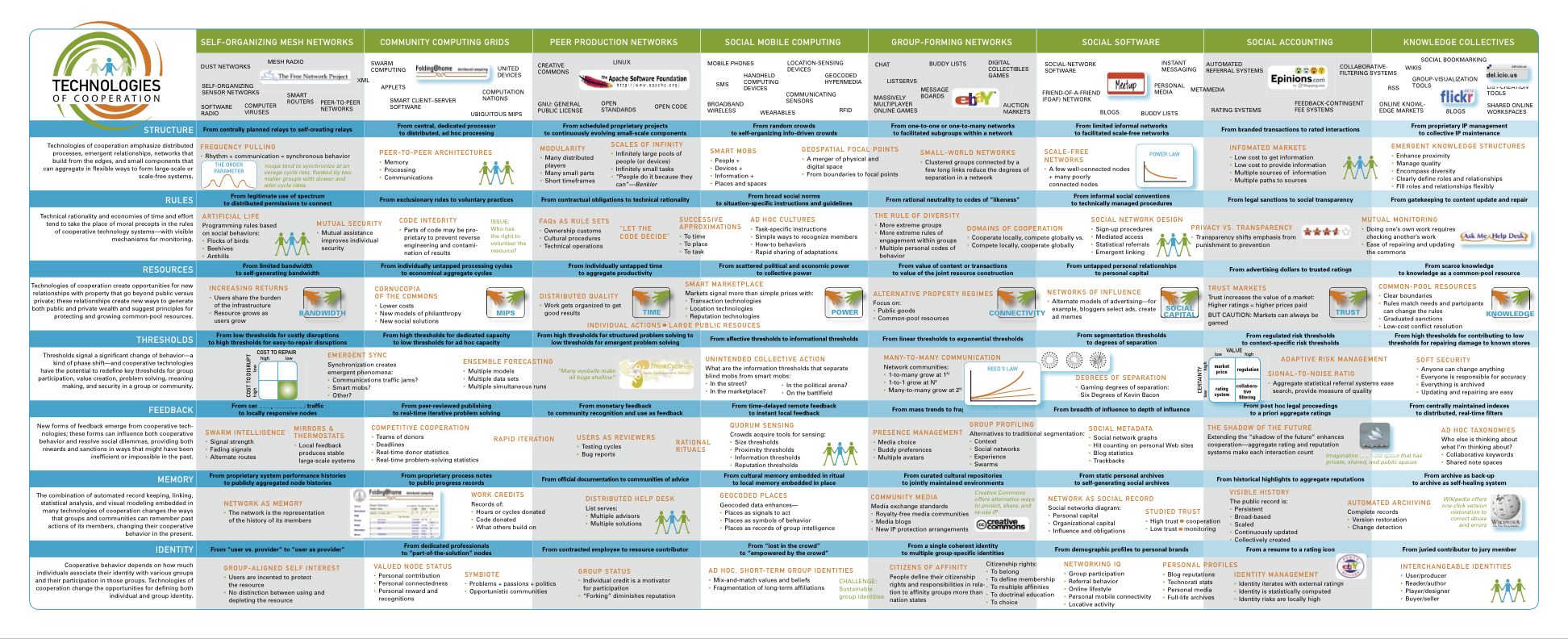
Just came across a great poster 'Technologies of Cooperation Map' outlining (defining?) Web 2.0 (without mentioning the word) on the Literacy of Cooperation resources page. Certainly gives a big picture!

Also some interesting videos and links on 'cooperative technologies', 'emergent democracy' and 'collective intelligence' including presentations looking at the creation of civic spaces and motivators for cooperation such as saving the world and love...

Link via Alex Steffan at WorldChanging

Sunday, 16 April 2006

Knowledge Metaphors

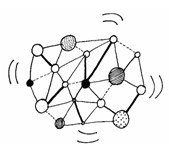
How we see 'education', 'schooling', 'learning', 'teaching' and 'assessment' has much to do with how we see knowledge. Here is a page that my wife Sue put together that nicely illustrates some different ways of seeing knowledge...

Knowledge gained from different disciplines is quite separate and can’t be easily integrated.


You can build knowledge from different disciplines, but some disciplines are more foundational than others. To what extent is knowledge restricted by its foundations?


Knowledge from different disciplines fit together like a jigsaw puzzle.


Integrating knowledge from different disciplines creates emergent understandings, new perceptions and new questions. Do our questions create the universe to be discovered?


Knowledge in one area is a reflection of the whole. Can you know the whole through complete knowledge of the part?


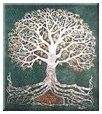
Knowledge is like a tree… mathematics explains physics explains chemistry explains biology explains love. Is there knowledge to be found outside the branches of the tree?


Knowledge is nested: Knowledge at each level includes and transcends earlier levels.


Each discipline illuminates a facet of the 'truth'. We need to bring in all perspectives to see the whole. What perspectives might be missing?


Knowledge is like a river… it moves and changes. If you dip your toe into the river tomorrow, you will experience a different river from today. There is no truth which stands still to be found.


No dout there are many other metaphors...

4 Quadrant Integral Theory might suggest all the above have some validity... eg knowledge gained from methods of inquiry in one quadrant should be applied very cautiously to other quadrants (buliding blocks) and knowledge that omits any quadrant gives only a partial view of 'reality' (elephant) and each quadrant contains parts which are wholes - holons (nested) and each quadrant is evolving with no end in sight (river)...

Graphics: MS Clipart Online