Tuesday, 13 December 2005

Forums for Transformation - Who Killed Benny?

“Benny was a woolly mammoth who was found frozen solid in Siberia. Benny died thousands of years ago in July. This year Benny appeared in the movie 'The Day After Tomorrow' - although his acting was a little stiff. Benny had a smashed hip, a broken leg and still had buttercups and flowering beans in his mouth that he was dining on for lunch when he was killed. Thousands of mammoths and other animals died with Benny. Who or what killed Benny and his friends?

This year saw record participation in our school’s online ‘Mystery Forums’ designed to promote transformative learning experiences for adolescents.

Why transformative learning? Until recently transformative learning has been the province of adult learning theory but there are several reasons to consider its inclusion for senior-secondary students transitioning into early adulthood.

Firstly, the transition to adult life often involves personal transformation as students move from a safe school environment to take on complex work, study and social responsibilities. Transformative learning equips students with the concepts and understanding necessary to make a success of this transition.

Secondly, when students are led to a deeper understanding of concepts and issues their fundamental beliefs and assumptions may be challenged leading to a transformation of perspective or worldview. Students who understand the nature of transformative learning may be better prepared for this process.

Thirdly, as we ask students to develop critical and reflective thinking skills and encourage them to care about the world around them they may decide that some degree of personal or social transformation is required. Students will need the tools of transformative learning in order to be effective change agents. Otherwise students may feel disempowered, become pessimistic about the future, fear change, or develop a degree of cynicism towards those who promote change.

Finally, we are living through a period of transformational change in society and culture. Students will be better able to deal with such change in their lives if they understand the nature of transformational change and the impact it has on individuals, groups, organizations and nations.


One of the many triggers for transformative learning experiences is a disorientating dilemma – a paradox, enigma or anomaly.

The popular ‘mystery forums’ allowed students to playfully question assumptions and worldviews through 10 dilemmas in an online forum. For example “Who Killed Benny?” is about the demise of mammoths in Siberia, Alaska and S. America thousands of years ago.

Students spent several weeks considering a wide range of possible scenarios from over-hunting to snap freezing to tsunamis to climate change to pole-shifts to disease and more… During that time they realised that there were many unquestioned assumptions and unchallenged worldviews underpinning the science and critical inquiry surrounding this issue.

Other dilemmas included:

In a chapter titled Learning to Think Like an Adult in Learning as Transformation Mezirow claims that transformative learning leads to greater competence in:

mindful learning
autonomous learning
self-directed learning
critical
reflection
self-knowledge
reflective discourse
dealing with change, transformation and uncertainty
dealing with "meaning perspectives" and worldviews
social responsibility
decision-making and problem solving

Most, if not all, of these are highly valued in emerging “21st century” curriculum for adolescent learners. I believe that online "mystery forums" can provide a useful, playful and safe learning environment for some aspects of transformative learning for adolescents.

Friday, 9 December 2005

U Turning a System

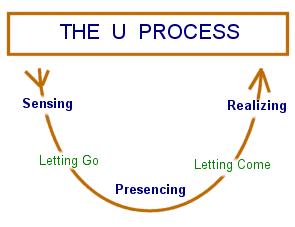
This week sees the end of the second year of our curriculum review process and there is a definite buzz in many yr 11/12 campuses around the State as future possibilities begin to emerge. Our consultative review process appears to be following the 'U Process' described in Presence by Senge et al.

Sensing – knowing the whole system as it is
Letting go - of historical processes and perspectives
Presencing - taking time to reflect
Letting come - allowing new processes to become realised

We have spent a year (2004) sensing as we looked at best practice and issues of concern - all the time trying to let go of our preconceived assumptions about the form that the educational provision for year 11/12 students should take. Instead we concentrated on establishing a set of shared values and purposes among all teachers, students, parents and the community.

This year we took time to reflect on the learning, assessment and teaching principles based on our shared values and purposes.

In 2006 we move to allow new forms and processes of educational practice to emerge through trialling project ideas that have recently begun to surface from teachers. At this stage most campuses don't plan to implement any significant changes until 2007.

It hasn't been easy to follow the U Process. In the beginning many people had definite ideas about the "causes of problems" while others knew how to "fix the system", and still others argued that nothing need to change.

Now two years down the track most teachers and administrators are reasonably comfortable to move toward the realization of all our new curriculum values, purposes and principles without any clear view of what it will look like...

I think the challenge for 2006 as we move up the 'U' will be to let the system (which is all of us) transform as new forms and processes emerge. The danger is that we might latch on to a "successful" trial project as "the solution" before other unexpected and more interesting possibilities emerge.

We certainly "live in interesting times"... :-)

Monday, 28 November 2005

Problem Solving

In a series of fascinating blog posts Dave Pollard has clarified for me ‘problem solving’ in ways that are informed by systems thinking, complexity science... and more holistic or integral approaches.

While many curriculum and syllabus documents nominate ‘problem solving’ as an important skill for students very few appear to describe this beyond simple problem-answer processes. Some have begun to refer to ‘problem posing’, ‘problem prevention’ and ‘problem solving’ - and the importance of using ‘systems thinking’ and ‘higher order thinking’ - but Pollard now makes me think we could be much more explicit about some of these processes…

I think many students and teachers will find his approach very useful.

This work is licensed under a Creative Commons License.

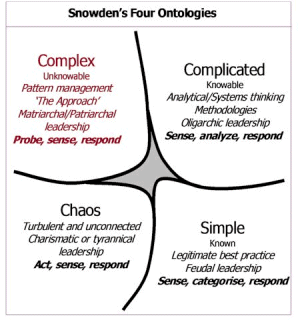
Dave Snowden describes four categories (ontologies) of systems each requiring different methods and tools for effective intervention. Using references from Pollard and Snowden:

Simple systems can be ‘known’. Within known limits we can predict the behaviour of the system and there is one clear ‘best practice’ for solving problems or making corrections. Effective methodologies: Sense, categorise and respond. These systems can be easily modeled are most suited to automation.

Complicated systems have many inter-relationships but they can be discovered. Methodologies can be developed following sufficient analysis to intervene in the system to achieve desired changes or corrections. Senge's 'systems thinking' and ‘system dynamics software’ are useful tools for dealing with complicated systems, where cause and effect is not obvious or simple, but is knowable. Effective methodologies: Sense, analyse and respond.

Complex systems have no knowable cause and effect relationships – there are just too many. Instead we need to focus on the management of patterns and the unpredictable emergence of new properties. Pollard calls these ‘wicked problems’. When analysis and subsequent solutions fail to solve a problem, or predict behaviour, it's often because approaches meant for complicated systems have been used to address complex ones. Effective methodologies: Probe, sense and respond.

A different approach is required. One that uses discovery (probing) rather than analysis, with an acknowledgment that not all can be known. Open Space Technology is one method that considers possibilities and options. It’s about knowledge-sharing and ideation of conversations rather than simply implementing an action plan. It’s about powerful learning, collaboration, and doing. Pollard also calls this ‘appreciative inquiry’.

Chaotic systems are turbulent with disrupted relationships. They require crisis management. However they can also be very useful and even necessary to move from one undesirable complex system to another more desirable one. Effective methodologies: Act, sense and respond.

If we are empowering students to be active participants as local and global citizens then they will surely need an understanding of the difference between simple, complicated, complex and chaotic systems. If we as educators are attempting to change educational systems we will need the same understanding.

Friday, 4 November 2005

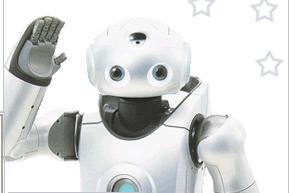
A more human looking robotic future/present

After posting the robot links last month someone sent me this one.

"Japanese scientists have unveiled the most human-looking robot yet - a "female" android named Repliee Q1Expo. She has flexible silicone for skin rather than hard plastic, and a number of sensors and motors to allow her to turn and react in a human-like manner.
She can flutter her eyelids and move her hands like a human.


She even appears to breathe."

I wonder how much a 'Roger Relief Teacher' version will cost? And will anyone notice if it goes to class or staff meetings instead of me? :-)

Saturday, 15 October 2005

Student Feedback on Integral Theory


Student response to Integral Theory over the last few months has been very enthusiastic. Although you can't read the left hand column in the linked doc you can see from the feedback summary that I touched on many concepts over 2.5 hrs. Some a little too briefly perhaps but I think it is important for students to get a clear sense of the coherency of the overall framework.

So far I have only introduced it to Level 5 English classes but I know of teachers internationally who have received very positive feedback from grade 9 and 10 students... so I'm keen to try it with other classes next year.

I'm about to run similar sessions for teachers so it will be interesting to compare feedback... For teachers I am hoping Integral Theory will provide a coherent conceptual framework that helps to make sense of some fundamental concepts underpinning the ELs and PY10 Frameworks such as: * Worldviews * Value systems * Systems Thinking * Disciplines * Transdisciplinary * Transformation *

Wednesday, 12 October 2005

Educating for a future that is already here

QRIO Robot

I've been looking at Sony's latest robot - QRIO. Susan Greenfield showed a video of a group of school girls having a very human-like conversation with QRIO at the July Thinking Conference.

The Sony web site has lots of info. These animations are pretty good - in Flash - see the second and fourth.

At this site there are more vids - one of QRIO throwing a ball ... and one with a group of QRIOs dancing ...

QRIO is a Science Ambassador for UNESCO and is touring the world.

Pity he is not yet for sale...

World's First Bionic Man

In May 2001, working as a high-power lineman 54 year old Jesse Sullivan was electrocuted so severely that both of his arms needed to be amputated.

Jesse now has bionic arms. See story and video clip.

Doctors took nerves that used to go to the arm and moved those nerves onto chest muscles. The nerves grew into the chest muscles, so when Jesse thinks “close hand,” a portion of his chest muscle contracts and electrodes that detect this muscle activity tell the computerized arm when to close the hand. So when he thinks “close hand” and his artificial hand closes.

Billion Dollar Industry Within 5 Years

enon, a service robot, comes in Citrus Yellow, Lily White and Lavender Blue for just $72,000.

10 of the robots have already been ordered by shops to provide guidance, escort guests, transport objects, and do security patrols. We could have one on campus: “You are late for class. Please move on before I SMS your teacher, the security guard, your parents...“ :-)

The price is expected to more than halve within a year and robot production is predicted to be a 1.2 billion dollar industry within 5 years.

Robot Car Wins $2 Million

Last week the robot car Stanley won $2,000,000 for crossing the finish line first in a US desert. It is not remote controlled - a computer does the driving.

Stanley was built using a diesal powered Volkswagon Touareq R5.

See a video-clip of Stanley on the downloads page at http://www.grandchallenge.org/

There was even a driverless motorcycle - Ghost Rider Robot - http://www.ghostriderrobot.com/

2005 is certainly THE year for robotics! What does this mean for students and the curriculum?

One way to engage students is through Robocup Junior where the challenge is to build robots that can dance to music, rescue someone in distress or kick a soccer goal. Robocup junior is inspired by Robocup International where the challenge is to "develop a team of fully autonomous humanoid robots that can win against the human world soccer champion team" by 2050.

Thursday, 14 July 2005

Thinking, Learning and Futures

Here are some of the key ideas I got from the presenters at this conference.


Thinking is about learning. Piaget said “Intelligence is knowing what to do when you don't know what to do.” (Claxton)

We now have fourth-generation theories on thinking/learning. Learning dispositions are transferable from one context to another and are transdisciplinary (Claxton).

We need to educate for the unknown by providing powerful conceptual systems, global perspectives and coherent big picture stories (Perkins, Eckersley, Olson, Slaughter).

‘Knowledge’ is problematic because it is increasing rapidly, is context fixated and for most people it is full of misconceptions (Perkins, Senge, Slaughter). Knowledge is a social phenomenon (Senge).

Local and global challenges are pressing and we require empowered positive thinkers capable of cross disciplinary synthesis, systems thinking, collaboration and shared intelligence (Eckersley, Moran, Ritchhard, Olson, Slaughter). We are beyond simplistic solutions (Moran, Senge, Eckersley).

Psychological and social well-being (mental, emotional, spiritual) are important for deep thinking and learning (Wood, Eckersley, Senge, Slaughter).

Spirituality (not religion) is a key emerging transformation of the late 20th/early 21st centuries (Senge, Eckersley, Olson).

Personal and social foresight requires a level of futures literacy as well as futures tools, methodologies and strategies (Slaughter).

Changes in Australian values, assumptions and access to ICT are leading to 'citizen centered' democracy where a market and economic forces are no longer the primary drivers in government and the public service bureaucracy. We need multidisciplinary risk-taking thinkers (Moran).

We need to be explicit about our assumptions and world views because they underpin our thinking and colour our perceptions (Senge, Olson, Slaughter, Varey). Memes and value systems are crucial factors in thinking, learning and the envisioning of desired personal and world futures (Barber, Perkins, Slaughter, Varey, Janson).

The world is not in crisis - our worldviews are (Varey). Our languages (eg mother tongue, bilingual, mathematical...) also filter our experiences, influence our comprehension and affect our sense of morality and hope (Gupta).

Thinking, learning and inquiry are important both within disciplines (ways of knowing and inquiry) and across disciplines (Perkins). What we teach is just as important as how we teach (Perkins).

We need to teach problem-prevention as much as problem-solving (Wood, Perkins). We need both individual and collective thinking - multiple intelligences and shared intelligence (Ritchhard, Wood, Moran). And collective creativity and inspiration (Mol).

With the advent of new 21st-century technologies individuals have access to knowledge and resources that can have an enormous detrimental impact on local and global communities. We need ethical understanding and spiritual perspectives (Olson, Slaughter).

Presenters
Marcus Barber - Swinburne
Guy Claxton – Bristol University, UK
Art Costa – California State University, Habits of Mind, USA
Richard Eckersley – National Centre for Epidemiology & Population, ANU, Australia
Sunetra Gupta – Mathematician, epidemiologist and author, Oxford University, UK
Jan Jansen - Sweden
Terry Moran - Secretary, Victoria Department of Premier and Cabinet, Australia
Jan Mol - Ad!dict Creative Lab - Brussels
Molly Olson - Eco Futures Australia, US Gov Advisor on Sustainability
David Perkins – Harvard, USA
Ron Ritchhard – Harvard, USA
Peter Senge – Society for Organisational Learning, USA
Richard Slaughter - Foresight International, Swinburne, Australia
Fiona Wood – McComb Foundation and Australian of the Year
Will Varey - Integral theorist, Australia

Thursday, 12 May 2005

Values and Memes


I have been thinking about Values and PY10 and the observation from some teachers that there might be a dominance of "middle-class values" of those consulted during the review and our subsequent documentation and thinking.

Some have asked interesting questions about recognising the the values of the full range of our students (eg generational poverty) and the complex relationship between student, teacher and community values - particularly in the context of globalisation and our location in the Asia-Pacific.

I have written something introductory about values, memes and Integral Theory in order to promote some discussion among those interested in this area...

Monday, 9 May 2005

Gates Crashing the Curriculum Party?


America's high schools are obsolete according to Bill Gates.

“By obsolete, I don’t just mean that our high schools are broken, flawed, and under-funded...
By obsolete, I mean that our high schools – even when they’re working exactly as designed – cannot teach our kids what they need to know today.”

Through the Gates philanthropic foundation he has spent nearly one billion dollars helping to rebuild or redesign 1500 US high schools. He doesn't claim to be an education expert but says that as head of a corporation and a foundation what he sees “leaves him appalled”.

He talks about how high schools fail to prepare most students for work, tertiary education and citizenship - because they were designed that way! He believes that in the past governments only required a small percentage of students to qualify for tertiary entrance but that today all students should do so. And he says that research has proved that all students can do so.

In his address to the recent US National Education Summit on High Schools he said that there are two arguments for better high schools:
  • the economic argument - in today's global economy it hurts us if all students are not being educated
  • the moral argument - we need to do something because it's hurting the students

He pointed out that as far back as 2001 India had almost a million more university graduates than the US - and that China now has twice as many graduates as the US. This puts the US behind in the international supply of knowledge workers - workers that are now only a mouse-click away.


The schools being funded by Gates are built on principles based around the “new three R’s“:

  • The first R is Rigor – making sure all students are given a challenging curriculum that prepares them for college or work;
  • The second R is Relevance – making sure kids have courses and projects that clearly relate to their lives and their goals;
  • The third R is Relationships – making sure kids have a number of adults who know them, look out for them, and push them to achieve.


How is Australia's secondary education system hurting?
What kind of education would business interests here promote if they began to put large sums of money into secondary education?

Saturday, 7 May 2005

Framework Mapping


I've been playing with mapping the new curriculum framework... :-)

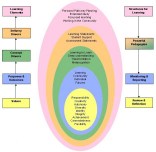
In this first one I have used a nested (holarchic) rather than hierarchic representation. I think holarchies better represent the notion of expansion and inclusion we might be after.
If you can't see it properly hold your mouse over it until you see the '<- expand ->' icon.

In the second version I have shaded the right hand side boxes to represent the notion that ALL stages are inclusive of ALL the curriculum principles - values to learning elements.

In the third version I have shown how extra words might be added to give some sense of the emergent whole for each level (called a holon). I am not happy with the words I have chosen but you get the idea...

The fourth version gets a bit more radical. I have changed some of the names trying to embrace different metaphors. On this doc I have started to look at other ways of describing the Learning Elements (don't really like the word 'challenges'...) .

I have also included Professional learning because feedback was critical that teachers didn't seem to be represented. Others would say that the learning refers to boths students and teachers. Anyway... I just put it in to see what people thought.

Finally here is a version from John exploring the idea of turning the pancake diagram on its side...


What do you think? Useful? Clumsy?

Monday, 11 April 2005

Making Sense of Student Development

I've sent out the next email installment on Integral Theory - this time looking at how various lines of development can be mapped across generic stages of growth. I'm not sure who will have time to read it given that reports are due this week!

PY10 leaders have begun to think about our college handbook for 2006. We need to look at our pre-requisites in terms of the ELs Standards and Progressions - this is no easy task because only a few of us have had time to look at them. Lots of work to be done here.

While on the subject of ELs I've been looking at the new Victorian ELs (VELs) to be implemented by all Victorian teachers in 2006! Also found links to the Northern Territory 'EsseNTials' and the South Australian ELs .

Quotes from the iNET Conference


“In the not too distant future Beijing will become the new New York.”
Jason Yat-sen Li - General Manager Insurance Australia Group


“Students are not choosing DDD jobs - Difficult, Dangerous and Dirty Jobs.”

“50% of current year 7 students will end up in some form of self-employment.“

“The greatest rate of jobs growth in Australia is in the retail industry. But we are not just talking about checkouts - the retail industry has career paths! “


Mary Nicolson - Australian Chamber of Commerce and Industry


“We need a unique national student ID to cope with the 80,000 students who move interstate per annum.”


Ken Smith - Queensland Director-General Education


“What if...? dare to make a difference.“


Derek Wise (UK) - Principal of Cramlington Community High School


“Our curriculum is driven by leading edge science and mathematics that will shape Australia's future in the next 25 years.“

"Mathematics is a textbook free zone.“


Jim Davies and Jayne Heath - Australian Science and Mathematics School


“ 'India' CD will be a required English text for the VCE in 2006.”


Kathe Kirby - Asia Education Foundation


“Literacy and numeracy standards have declined nationally. While educators are interested in other literacies these are the only ones for which we have hard data and can therefore draw reliable conclusions. While educators have argued that other aspects of student education have improved this cannot be demonstrated.

Therefore we will stick with what we know. Education standards are declining. There is a crisis in teacher quality.“


Andrew Leigh - Economist and researcher at ANU


“There are many generations of students and teachers:

Builders - born before 1948
Boomers - born before 1963
Generation X - born before 1980
Y Generation - born before 1995
Cyber Generation
How much do educators know about the 'cyber generation'? “


Thao Nguyen - final year at University of Sydney

- Australian Youth Representative to the UN General Assembly in New York (2004)


“The future of Australian curriculum is in Tasmania.“

“A key message I'll take back to the UK is what Queechy and other schools are doing in Tasmania.“


Professor David Hargreaves (UK)

Wednesday, 6 April 2005

Earth to Roger...

Photonics, Biomimetics, Nanotechnology, Robotics, Cryptography... These are the leading edge areas of science and mathematics that years 10-12 students and teachers study at a senior secondary school in South Australia.

I have just returned from the International iNET Conference in Melbourne and my head is still somewhere on another planet! When I do come back to Earth I have decided that I need to go to the Australian Science & Mathematics School (ASMS) in Adelaide.


In this school the students and teachers learn together about leading edge science and mathematics that is going to transform all our lives over the next 20 years (according to an Australian Government Report). Just briefly some features of the school are:
  • Years 10-12 and teachers work together on interdisciplinary inquiry.
  • Compulsory 'Central Studies' include study Mathematics and Abstract Thinking, Sustainable Futures, Nanotechnology, The Earth and Cosmos and Biotechnology.
  • University modules to be studied include Robotics, ICT, Bioinformatics, The Politics of Energy and Electronics.
  • Students go home at noon on Tuesdays so teachers can participate in professional inquiry and research with Flinders University.
  • Year 12 students finish with Certificated Accreditation for University entrance.

According to ex-students now at university they are far better prepared for learning that students from other schools.


I wonder if all Tasmanian Colleges can teach science and mathematics in the same way? When I think back to my days at uni what I remember best is the work I did on leading edge science such as holograms - I still have the 3D holograms I made of chess pieces...

More on other conference sessions soon.

Wednesday, 23 March 2005

Making Waves

Here are Andrew and I smiling like two Cheshire cats in my first PY10 interview using MyVoice and Producer. The PY10 team wanted to promote some of the great work teachers are doing and heard about Andrew's innovative use of some junk mail in his mathematics class.


The idea was that we email short (2-3min) interviews for people to view. Unfortunately my expertise as a sound recorder was sadly lacking (as was my interview technique) and the interview sounded as though we both had speech impediments. Sorry the file is too big to link to from here so you can't see it unless you come and visit.


Stefan came to the rescue and taught me all about de-essing using a graphics equalizer - thanks Stefan. I learnt how to load the wave file and cut down the high frequencies that were lisping our s's and t's - this was a big improvement although Andrew wasn't entirely convinced...

Anyway it seemed to come out OK because I had lots of very positive feedback from teachers. I think Andrew also enjoyed making some waves by being in a PY10 interview - something many of his colleagues would not have expected...

Thanks Andrew. Now for my next victim...

Monday, 21 March 2005

Heaps happening

With 11 PY10 leaders and 120 teachers so much is going on that the PY10 Management Group is finding it hard to keep up with it all. PY10 Facilitators are going to start doing brief weekly email updates that I will summarise and send back to all Learning Groups so that we can share progress across the college.

Most Learning Areas have begun projects of some kind including preparing new units, inviting outside speakers and organising professional learning.

The Management Group is currently planning a half-day event for all the PY10 Learning Group Leaders in the week after Easter. This will be the first time we will all meet with time for some real dialogue.

On the 3rd April three of the PY10 Facilitators are going to a Transformative Learning Conference in Melbourne called 'The Tipping Point' sponsored by iNet.

Sunday, 20 March 2005

Roger 007!

OK I'm not really going to spy on anyone but the digital voice recorder that the college has just purchased is also available through websites that supply 'spy gear'! Dirk and I wanted to record sound easily and while mobile phones, iPods and PDAs can record sound they are not very good in what is called 'conference mode'. After much internet research Dirk found the MyVoice brand which is half the price of its competitors.


The device is about the size of a small pager so it's very unobtrusive and it's designed to pick up sound some distance away. Initial tests have proved that it does the job.


I'm now working on my first project - a PY10 interview with pictures that I will put together using MS Producer which is a free add-on for MS PowerPoint.


Psst... I also saw a camera inside a pen that you can buy :-)

Thursday, 17 March 2005

Growth Coaching

20 AST3s and PY10 leaders participated in a Growth Coaching session at college today.

GROWTH is an acronym for Goals - Reality - Options - Will - Tactics - Habits and I found it did provide a very useful structure and process to follow when assisting someone to clarify and move towards meeting their goals - particularly when they are also aware of the process.

As presenter John Campbell said "most of the process was 'common sense' but perhaps not 'common practice' ." I have been hearning a bit about Integral Coaching recently. This brings in the concepts of the 4 quadrants, streams of development and different types from Integral Theory. None of this was mentioned in John's presentation but I think it might be well worth following up.

I will probably use the GROWTH structure with my CA students - perhaps even teach them the process. Some have suggested using it for PY10 processes as we move through the year - a definite possibility I think. I wonder if we can incorporate elements of Integral Coaching as well?

Monday, 14 March 2005

To theorise or not to theorise...

After spending the last few months learning and talking about Integral Theory I finally have got to the point where I have begun to write about it a little more deeply. But this is no easy task!

Ken Wilber, who has done much to develop Integral Theory has been called the 'Einstein of Psychology' because aspects of the theory are as radically new as Einstein's theories in science were nearly 100 years ago. However I'm hoping that applying what Wilber and others have come up with is a little more straight forward.


I'm keen to promote discussion of Integral Theory because reports from teachers who are using it to design curriculu and courses are very positive. Many have also used it in their classes and some have great responses from students who found it has some useful tools for research, problem-solving, interdisciplinary inquiry and understanding self and others.


The paper I am writing sketches out some of the areas of Integral Theory that I would like to discuss for our college curriculum - but that took up 20 pages! Not quite the short introduction I was planning.


I have sent what I have written to a number of people locally and internationally and initial responses have been very positive. However while most believe that the information is important (and some believe even critical) to understanding education for years 11 and 12, views vary widely on whether teachers will have the time or inclination to look at such a theoretical perspective of curriculum.


Some believe all college teachers should read the paper and that most would find it very useful both in thinking about curriculum and in their own teaching practice. Others believe only a few teachers would want to look at it.

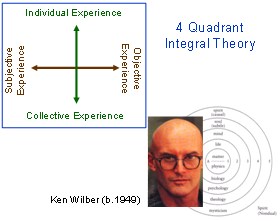
Wilber's integral perspective maps human experience across 4 quadrants.

The 4-Quadrant Integral Model provides a comprehensive map of human experience and capacities which is being applied to many fields of human endeavour including global ecology, business and organizational practice, medicine and international politics. If we put this in the context of student learning we obtain an integral map that might represent different domains of a curriculum:


Integral approaches to curriculum could provide:

  • Frameworks for learning, research and problem solving processes
  • Lenses to ensure structures and processes are more balanced and inclusive
  • Tools for transformational change
  • A common language for transdisciplinary inquiry


So... where to from here? Perhaps there are several possibilities.


  1. Some who have read the paper are already keen to form a group to discuss it in some depth.
  2. The paper could be made available for anyone who wants to read it.
  3. I have begun to break it down into small chunks - the first of which I have just sent as an email to all teachers at Hobart College and a few interested teachers in other colleges.
  4. Offer small lunch-time forums after Easter - perhaps after the next chunk goes out in another email.

In the meantime I will work on a second draft based on all the feedback I have received so far - thanks to all those who have sent me comments.

Tuesday, 8 March 2005

Guaranteeing Futures

Today the cross-college leaders/managers met to discuss how the college might deal with all the agenda and programs (shown appropriately blurred on the left) for colleges within OPCET.

We used Tom's "bubble protocol" (which worked very well) to begin a mapping process of how various issues such as the Completion Certificate, the raising of the leaving age, TQA certification... will impact on various cross-college roles.

Although some work was done last year it is very clear that we all need to work together to make any sense of what might be appropriate college responses. Our next step is to have Reg from the TQA come and talk with the group.

Sunday, 27 February 2005

A dramatic restructure!

We now have our new college management, leadership and PL structure for 2005 up and running. It's taken some time to clarify role descriptions for the new positions and these will continue to evolve.

The new structure is focussed on supporting teachers with classroom learning, teaching and assessment. Subject areas have been combined into Learning Area Groups (the green areas on the map) with the deliberate intention of placing different areas together - eg Mathematics and Visual Arts.

The number of people with PY10 responsibility and time release has increased from a leadership team of 3 in 2004 to:

  • PY10 Management - 2
  • PY10 Facilitators - 3
  • Py10 Learning Group Leaders - 6

This gives a total team of 11.

All cross-college roles (purple area on map) will have support in PL and implementation issues to do with the wider State of Learning Agenda - particularly Guarenteeing Futures.

Wednesday, 23 February 2005

GUTs and TOEs


Over the last few months I have been involved with an international online group on Integral Theory. Integral Theory has developed significantly over the last 25yrs with many international groups searching for Grand Unifying Theories (GUTs) and Theories Of Everything (TOEs). We have been discussing Ken Wilber's 4 Quandrant model where all human experience is divided into inner and outer experience and individual and group experience giving 4 quadrants.


Anyway during one of our telephone conference calls we were challenged to come up with “integral biographies” of ourselves to share on an online forum as a way for others to get to know us better. I was quite pleased with my handiwork so I thought I'd share it. More on Integral Theory later...


First an integral pictorial bio without fussing about placement in quadrants...


And then mapped as a 4 quadrant integral bio...


An interesting exercise...

Friday, 11 February 2005

Joining the Independents and Privates

Yesterday I got a picture (with gritted teeth?) of the new Hobart College PY10 Leadership Team (Hazel, Heather, Sheenagh, Tony) at ZEPs on the way to Newstead College.

The large meeting (60?) was the first between State colleges and private and independent schools who have recently joined the State Colleges' PY10 process. It went very well with many of the same issues being voiced about directions in education that were expressed by college teachers last year.

We all read and discussed a summary paper on last year's PY10 process and outcomes written by the State PY10 Management Team. There were many suggested changes to the paper and a new edited version will be sent to all colleges and schools by the end of next week.

A number of people from private and independent schools understandably found it a little overwhelming joining the PY10 process after one year. Some called for a glossary to help with terms - some of which have almost become second nature to college teachers over the last year - how quickly we change... Mind you even college teachers still find terms like 'transformational' or 'transdisciplinary' hard to grapple with. :-)


The next stage of the State process will be to write some issues papers beginning with the intended outcomes for 11/12 curriculum drafted last year and moving forward to possible curriculum frameworks that might enable these to be realised by year 11/12 students from 2008.

Tuesday, 1 February 2005

PY10 on holiday!

Some time ago I discovered that you can rent holiday accommodation from LJHooker. Sue (my wife - lhs) and I got a 3 bedroom house for a week - here I am (rhs) roughing it with friends at Denison Beach just north of Bicheno:


I've done quite a bit of reading - some really interesting stuff on Integral Theory in physics and education. The physics integral theory was about Ervin Laszlo's Connectivity Hypothesis looking at the relationship between consciousness and the quantum foam. I like the idea that the quantum foam might be holding information about the entire universe in the form of a hologram - a record of everything that has ever happened in the universe... intriguing...


I've spent a lot of time in the garden - I even have cucumbers because our early warm spring give us such a long summer for Tassie. And I can now use the internet to make free international phone calls (using Skype) and have joined in several international 'concalls' on Integral Education - but more about that later...

Thursday, 27 January 2005

Why am I Blogging?

I've decided to keep a web log of my professional educational experiences this year. My thinking is that I (and hopefully others) will gain as I record and reflect on my activities and musings.

I've been learning about blogs through trial and error on a Hobart College blog (internal access only) and I have recently joined a blogging class on the net.

I'm going to cheat a little and repost some of my college blog entries into this blog - but back-date them for continuity. (This post was actually written on the 25th March.)

So to begin... what am I up to at the moment?

This year I'm continuing my role (50% of my time) as on of 20 Project Officers in the Post Year 10 (PY10) Curriculum Review so I guess we start where the PY10 Team left off from last year... some pretty graphics :-)

These represent our new agreed values, purposes and outcomes for year 11/12 education in Tasmania - and a mapping of what it means to be a learner in the 21st century.